Geometers
Where Is the Image? — Exploring Reflection with Mirrors
Where Is the Image? — Exploring Reflection with Mirrors
There is an image behind a mirror.
But there is nothing actually there.
Can you find its position?
And what happens when light is allowed to reflect more than once?
With two simple investigations, we can discover both the location of a virtual image and the surprising appearance of multiple images from a single object.
Part 1 — Finding the Image Behind a Mirror
A plane mirror was placed vertically on a table.
A large pencil was placed in front of it.
Because the pencil was larger than the mirror, only part of it could be seen in the reflected image.
A second, identical pencil was then placed behind the mirror.
The goal was simple:
Can you position the second pencil exactly where the image of the first pencil appears to be?
At first, the two pencils appeared to align.
But when the observer moved sideways, the alignment disappeared.
The second pencil was adjusted repeatedly.
Eventually, a position was found where:
The real pencil and the reflected image appeared to coincide from every viewing position.
The position of the second pencil marked the apparent position of the virtual image.
The Remarkable Result
The distance from the real pencil to the mirror was measured.
Then the distance from the mirror to the second pencil was measured.
They were equal.
Object distance=Image distance
This is one of the fundamental properties of a plane mirror.
The image appears to be located exactly as far behind the mirror as the object is in front of it.
But there is no physical object at that location.
The image is virtual.
Why Does It Work?
This is a perfect point to ask visitors to investigate using geometrical optics.
Choose a point on the pencil.
Draw rays travelling from that point toward the mirror.
Reflect those rays according to the law of reflection.
Now extend the reflected rays backward.
They appear to originate from a point behind the mirror.
Repeat this for different points on the pencil.
The complete virtual image emerges.
A Better Experimental Test
The sideways movement of the observer is actually an important part of your experiment.
If the second pencil is not exactly at the image position, parallax appears.
Move your head from left to right.
If the image and the second pencil move relative to each other, their depths are different.
When there is no relative motion, the two are at the same apparent depth.
This is essentially a simple optical method for determining the position of an invisible object.
Part 2 — One Object, Many Images
The second investigation reveals another surprising property of mirrors.
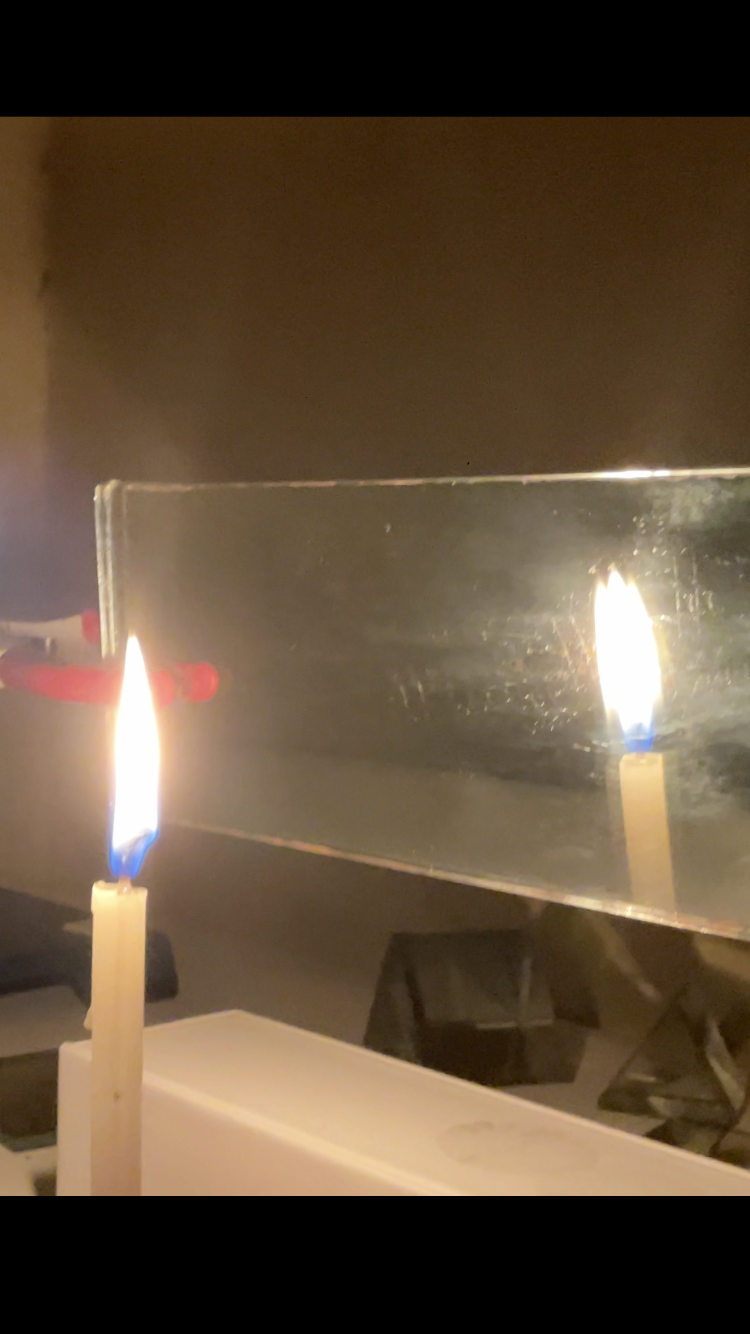
A thick glass mirror was placed in front of a bright object.
A light stick was used first.
When viewed approximately perpendicular to the mirror, only the expected image was obvious.
But as the viewing angle became larger, additional images appeared.
The effect became even clearer in a dark room with a candle.
Instead of seeing a single image, multiple images could be distinguished.
Why Multiple Images?
A thick mirror is not optically just a single reflecting surface.
It contains several interfaces.
For example:
air → glass → reflective coating → glass → air
Light can undergo reflections at more than one of these surfaces.
Some of these reflections produce images that are extremely weak.
Under ordinary viewing conditions, they are difficult to notice.
But at larger viewing angles, the geometry and relative brightness of these reflected images change, making the additional images easier to see.
Why Use a Candle or Bright Light?
This is an important question for visitors.
The additional reflections are much weaker than the main reflection.
A bright source produces enough light for these faint images to become visible.
A dark room helps further because there is less competing background light.
This is why the candle experiment is much more revealing than trying the same thing with a dim object.
The Interesting Question
The experiment leaves several things to investigate:
Why do additional images become visible only at larger viewing angles?
And:
Why does a thick mirror produce more than one image?
Visitors can investigate:
- The different glass surfaces.
- The reflective coating.
- Fresnel reflection.
- Angle of incidence.
- Relative brightness of the images.
- Separation between the multiple images.
This is a beautiful example of a phenomenon that is normally hidden by the design of everyday objects.
The Deeper Connection
There are actually two different scientific ideas hiding in this experiment.
First:
We can determine the location of something we cannot physically touch.
The virtual image is invisible as an object, yet its position can be experimentally measured.
Second:
A seemingly simple optical component can contain several optical paths.
The thick mirror is producing information that is normally hidden because one reflection is overwhelmingly brighter than the others.
Both are good examples of an important experimental principle:
Careful observation can reveal effects that ordinary observation hides.
Continue the Investigation
The experiment you've just explored is only the beginning. Our hands-on investigation sets are designed to help you recreate, extend, and deepen these ideas through observation and experimentation.
Every investigation has the potential to lead to a new question. If you discover something interesting, improve the experiment, or develop a new variation, share it with the Geometers community. Your work may inspire others and could even be featured here.
Keep experimenting. Keep questioning. Keep discovering.
Couldn't load pickup availability
Share