Geometers
Seeing the Invisible with Light
Seeing the Invisible with Light
Air is invisible.
Water vapour is almost invisible.
Hot air rising from a flame is invisible.
Even the path of a laser through clean air is usually invisible.
So how can we detect what is there?
Sometimes, we only need to watch what happens to light.
Part 1 — One Prism, Two Critical Angles
The experiment begins with a glass prism and a laser.
The laser enters the prism and reaches its second interface—the boundary between the glass and air.
The prism is adjusted until the laser undergoes total internal reflection.
At this point, the angle of incidence is large enough for total internal reflection at the:
glass–air interface.
But is this angle a property of the glass alone?
To investigate this, the prism is slowly lowered into water.
The important part is that the same interface that was previously in contact with air is now immersed in water.
Something remarkable happens.
The total internal reflection disappears.
The laser escapes from the prism into the water.
The angle had not changed.
The prism had not changed.
Only the material on the other side of the boundary had changed.
This demonstrates an important idea:
The critical angle belongs to an interface, not to a material alone.
An angle that is greater than the critical angle for a glass–air interface may still be smaller than the critical angle for a glass–water interface.
The prism can then be rotated further while immersed in water.
Eventually, total internal reflection appears again.
This gives a direct experimental comparison between:
- Glass → Air
- Glass → Water
This is an excellent experiment because you are changing only one variable: the second medium.
Part 2 — Making the Path of Light Visible
The laser beam could be seen clearly once it entered the water.
The water was not perfectly optically invisible.
A small amount of light was scattered toward the observer.
That scattered light revealed the path of the beam.
But the same laser travelling through ordinary air was much harder to see.
This raises another question:
Can we make something invisible visible by adding particles that scatter light?
Part 3 — Revealing Vapour with a Laser
A boiler was used to produce vapour.
The laser was directed through the rising vapour.
Now the path of the laser became visible.
But it was not stable.
Sometimes the path appeared as a continuous streak.
Sometimes it was broken.
Sometimes only parts of the beam could be seen.
This changing appearance reflects the constantly changing structure of the vapour and the surrounding air.
The laser becomes a probe.
It reveals something that would otherwise be difficult to observe.
A very nice open question for users is:
Why does the laser path continuously appear, disappear, and break into different shapes?
This can lead you toward scattering, condensation, turbulent flow, and changes in the density of the medium.
A Connection to Particle Physics
The observation has a beautiful conceptual connection to particle detection.
In a cloud chamber, charged particles themselves are not directly visible.
Instead, their passage through a supersaturated vapour triggers condensation along their trajectories.
The resulting droplets reveal the path of the particle.
The laser experiment is not the same physical mechanism—the laser path is mainly being revealed by scattering from droplets or particles—but the underlying experimental philosophy is similar:
An invisible object or process can become visible through its interaction with a surrounding medium.
Part 4 — Strange Patterns on the Wall
When the laser passed through the vapour and reached a wall, something even more surprising appeared.
Instead of a simple bright spot, there were patterns:
- Bright regions
- Dark regions
- Circular structures
- Ring-like patterns
- Complex moving structures
The vapour is a dynamic and complicated optical medium. The patterns can potentially involve a combination of:
- Diffraction
- Scattering
- Refraction through density variations
- Interference between different parts of the distorted beam
- Droplets acting as small optical elements
That actually makes the observation more interesting.
Why does a beam that begins as a simple laser spot develop rings and complex bright–dark structures after passing through vapour?
Part 5 — Seeing Hot Air
The final investigation is particularly elegant.
We know that the refractive index of air depends on its density.
Hot air is less dense than cooler surrounding air and therefore generally has a slightly lower refractive index.
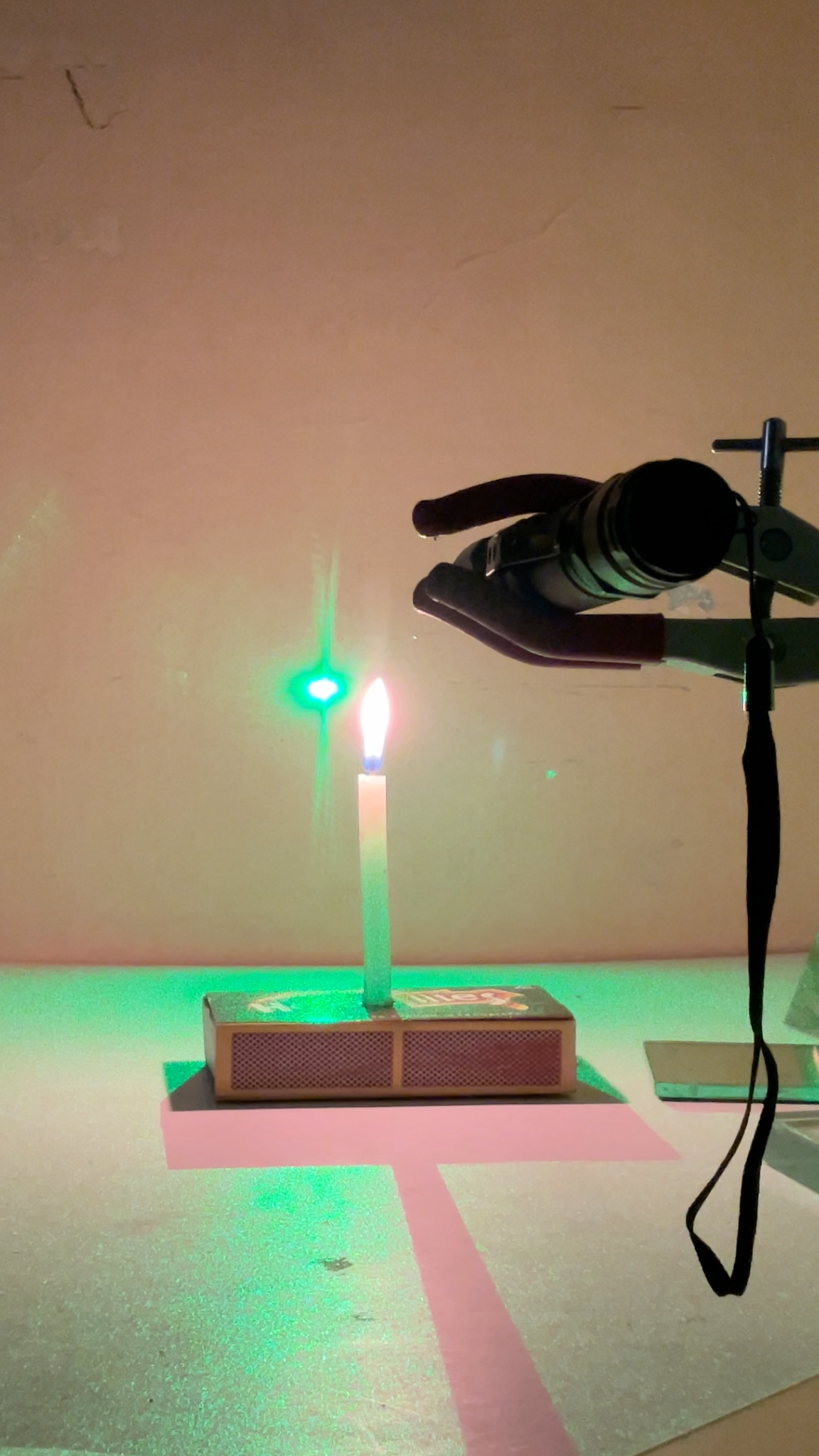
A candle was placed beneath the path of the laser.
The beam passed through the rising hot air.
On the wall, the position of the laser spot began to move.
As the flame flickered and the rising air changed, the laser spot also fluctuated.
The invisible motion of hot air had become visible through the changing direction of light.
This is essentially the same broad optical principle behind phenomena such as the shimmering appearance of hot air above a road.
Light passing through regions with continuously changing refractive index follows a changing path.
The Central Idea
Light does not merely allow us to see objects. Light can also be used as a probe to investigate things that are otherwise invisible.
Continue the Investigation
The experiment you've just explored is only the beginning. Our hands-on investigation sets are designed to help you recreate, extend, and deepen these ideas through observation and experimentation.
Every investigation has the potential to lead to a new question. If you discover something interesting, improve the experiment, or develop a new variation, share it with the Geometers community. Your work may inspire others and could even be featured here.
Keep experimenting. Keep questioning. Keep discovering.
Couldn't load pickup availability
Share