Geometers
Seeing Magnetic Fields in 2D — Reconstructing a 3D World
Seeing Magnetic Fields in 2D — Reconstructing a 3D World
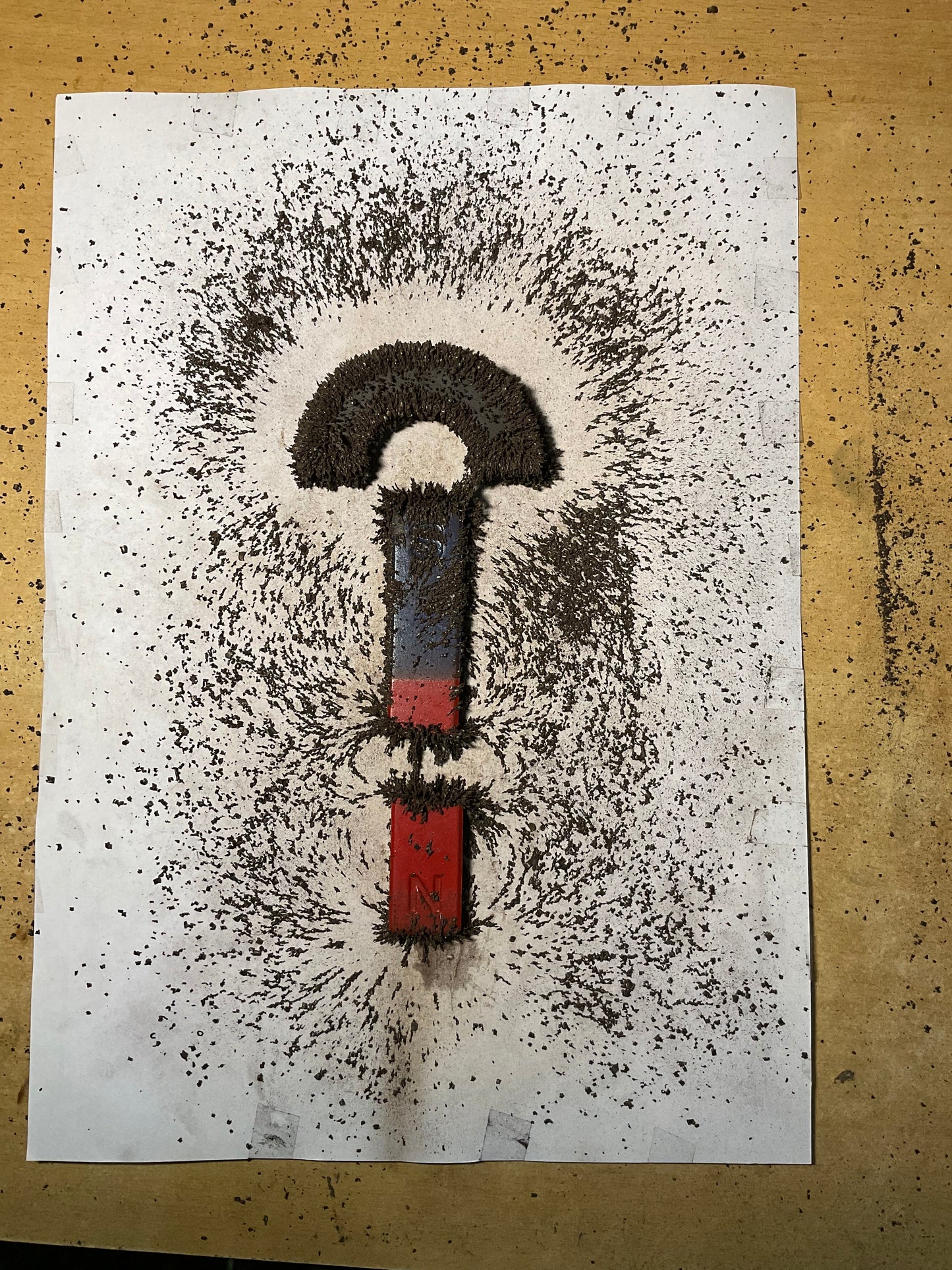
Magnetic field lines drawn by iron filings look like hidden patterns emerging from nowhere. But these patterns are only 2-D slices of a much larger 3-D magnetic structure. By changing the orientation of magnets and capturing multiple field patterns, we can begin reconstructing the invisible magnetic world — similar to how CT scans reconstruct the inside of the human body.
What You Observe
When iron filings are sprinkled over a sheet placed above a magnet, the filings align themselves along the magnetic field direction, revealing intricate curves.
Different magnet arrangements create dramatically different patterns:
- Single bar magnet
- Two attracting magnets
- Two repelling magnets
- Ring magnets
- Complex magnet combinations
Each image is only a slice of the full 3-D magnetic field.
Core Scientific Idea
The patterns seen on the sheet are not the full magnetic field. They are 2-D intersections of a 3-D field structure with a plane.
The magnetic field exists in all directions around the magnet:
The iron filings reveal the field behaviour only on one surface.
If we rotate the magnet or observe from different planes, we obtain additional slices of information. Combining many such slices allows us to infer the hidden 3-D structure.
Connection to CT Scans
This is conceptually similar to how a CT scan works.
A CT scanner does not directly see a complete 3-D organ. Instead, it captures many 2-D projections from different angles and reconstructs the 3-D structure computationally.
This makes the experiment a beautiful introduction to:
- Electromagnetism
- Tomography
- Inverse problems
- Scientific imaging
- Computational reconstruction
Why This Experiment Is Interesting
Most people think magnetic field lines are “the field itself.” But this experiment reveals something deeper:
- Observations depend on viewpoint
- 2-D data can encode 3-D information
- Complex systems can be reconstructed from projections
- Scientific instruments often infer hidden structures indirectly
Exploration Ideas
Basic Level
- Compare patterns from different magnets
- Observe attraction vs repulsion
- Identify symmetry
Intermediate Level
- Rotate the magnet and capture images
- Compare slices from different orientations
- Predict unseen regions of the field
Advanced Level
- Reconstruct approximate 3-D field geometry
- Use image processing to analyse patterns
- Explore analogy with tomography algorithms
Continue the Investigation
The experiment you've just explored is only the beginning. Our hands-on investigation sets are designed to help you recreate, extend, and deepen these ideas through observation and experimentation.
Every investigation has the potential to lead to a new question. If you discover something interesting, improve the experiment, or develop a new variation, share it with the Geometers community. Your work may inspire others and could even be featured here.
Keep experimenting. Keep questioning. Keep discovering.
Couldn't load pickup availability
Share