Geometers
Investigating Sunlight: Tracing the Geometry of Light
Investigating Sunlight: Tracing the Geometry of Light
We see sunlight everywhere.
But what can sunlight teach us about the way light travels?
Can we use a shadow to trace the direction of light?
Can a simple magnifying glass reveal something about the angular size of the Sun?
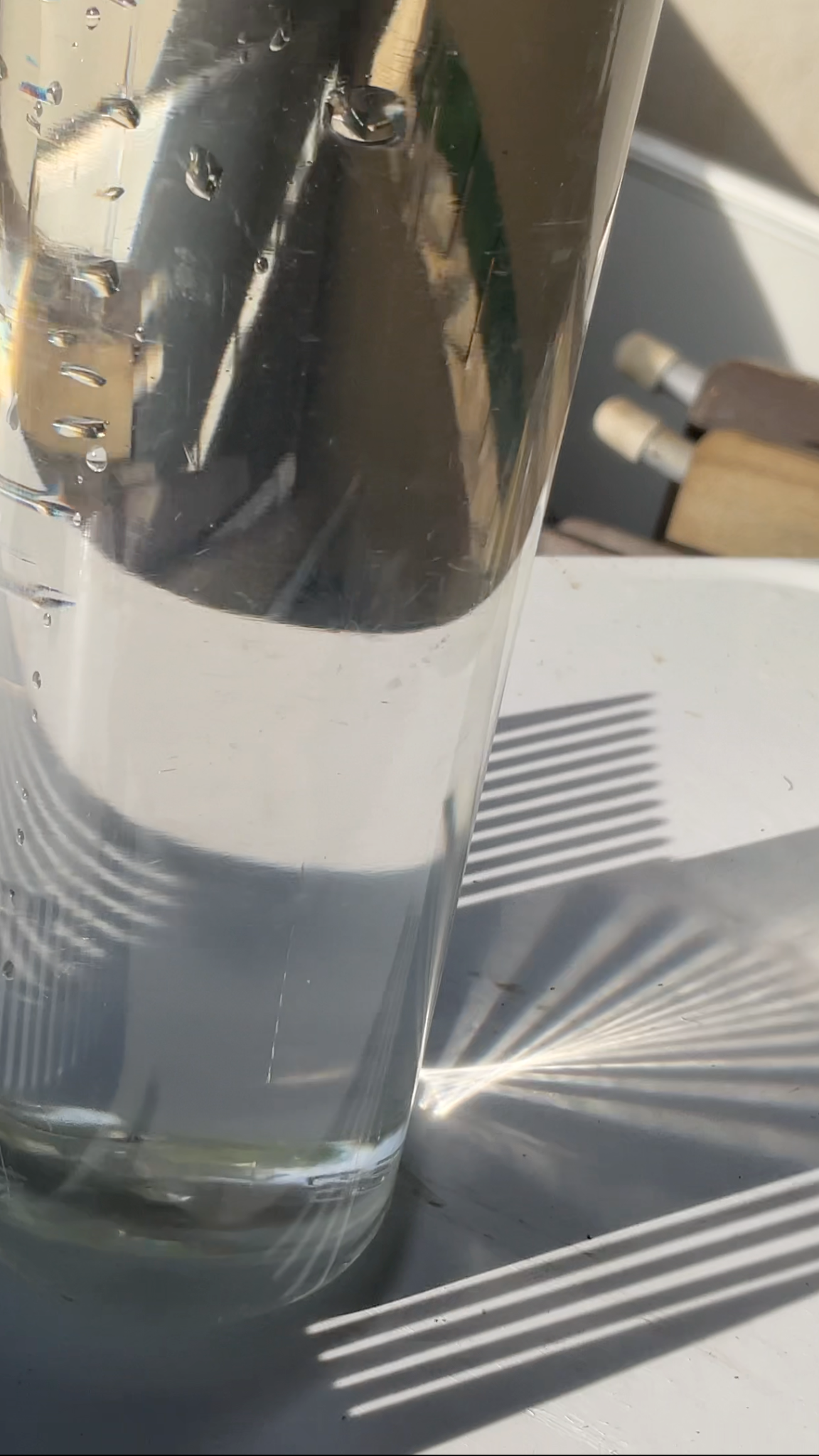
What happens when sunlight passes through a cylindrical body of water?
In this experiment, sunlight becomes the experimental tool.
Part 1 — Finding the Focus of Sunlight
The first investigation used a magnifying glass.
Sunlight was allowed to fall on the magnifying glass and the transmitted light was projected onto a white surface.
By moving the magnifying glass, the bright spot could be made smaller and smaller.
At one particular position, the spot reached its minimum size.
This position was used to estimate the focal length of the magnifying glass.
The experiment gives a very intuitive meaning to focal length:
The focal length is related to the distance at which nearly parallel incoming rays are brought to their smallest spot by the lens.
But Why Doesn't the Sun Become a Perfect Point?
This was one of the important observations.
Even when the magnifying glass was carefully positioned, the bright spot did not become an infinitely small point.
The reason is fundamental.
The Sun is not a point source.
It has a finite angular diameter in the sky.
Light from the upper edge of the Sun and light from the lower edge arrive at slightly different angles.
The lens therefore focuses them to slightly different locations.
The result is a small but finite solar image on its focal plane.
The image formed by an optical system depends not only on the lens, but also on the angular extent of the source.
Part 2 — Using a Comb to Trace Sunlight
The next investigation used a comb.
The comb was placed in sunlight and its shadow was allowed to fall on a writing board or white surface.
The individual teeth produced a pattern of alternating light and dark regions.
The shadow therefore provided an indirect way of observing the geometry of the incoming sunlight.
Because sunlight reaching the Earth is approximately composed of nearly parallel rays, the shadows of the comb teeth initially preserved the geometrical arrangement of the object.
Bringing the Magnifying Glass Into the Experiment
The magnifying glass was then introduced between the comb and screen.
Now the rays were no longer simply travelling approximately parallel.
The lens caused them to converge.
As the screen position was changed, the shadow pattern changed.
Near the region where the rays crossed, the pattern became compressed.
After the rays crossed, the geometry of the pattern changed again.
The shadow could appear inverted.
This is an important observation because it makes a normally invisible ray crossing visible through the changing shadow pattern.
The Shadow as a Ray Tracer
This was one of the deeper ideas from the experiment.
You cannot normally see a ray of light travelling through empty space.
But you can see what happens when those rays interact with an object.
The comb therefore acts almost like a collection of probes.
Its shadow tells us about the directions of the rays illuminating it.
In this sense:
A shadow is not merely the absence of light. It can be used as evidence about the geometry of the light producing it.
Part 3 — A Cylindrical Water Lens
The next experiment was particularly interesting.
A transparent cylindrical tube or container was filled with water.
Sunlight was allowed to pass through it.
Unlike the magnifying glass, the cylindrical water body did not focus the sunlight to a single point.
Instead, it produced a short-distance line focus.
This is because the cylinder has curvature in only one transverse direction.
It acts approximately like a cylindrical lens.
Why a Line Instead of a Point?
Consider the two directions separately.
Across the curved width of the cylinder, the surface bends the rays and produces convergence.
But along the axis of the cylinder, there is essentially no corresponding curvature.
Therefore, the rays converge in one direction while remaining relatively unchanged in the other.
The result is a line focus rather than a point focus.
This provides a very visual demonstration that:
The geometry of an optical surface determines the geometry of its focus.
A spherical lens tends toward a point focus.
A cylindrical lens produces a line focus.
Part 4 — Looking at Shadows Outdoors
The experiment was then taken outdoors.
The comb was used again to observe its shadow directly in sunlight.
Because sunlight arriving from the Sun is approximately parallel over the scale of the experiment, the shadow pattern provides a simple representation of parallel illumination.
When the magnifying glass is introduced, these approximately parallel rays converge.
The shadow pattern therefore changes accordingly.
The geometry that is normally represented only with textbook ray diagrams becomes something that can actually be observed.
Another Interesting Observation with the Cylinder
The cylindrical water lens produced another interesting geometry.
After passing through the cylinder, the rays appeared to diverge from a location associated with the cylindrical optical system.
The shadow pattern therefore provided a way of investigating the effective focal behaviour of the water-filled cylinder.
This was particularly interesting because the water itself does not look like a conventional lens.
Yet when contained inside a curved transparent boundary, it becomes an optical element.
The Deeper Idea
The most important message of the experiment is not simply that a magnifying glass can focus sunlight.
It is that light geometry can be investigated indirectly.
We cannot normally see the rays.
But we can observe:
- Where they converge.
- Where they diverge.
- How shadows change.
- Where an image forms.
- How the shape of an optical surface changes the focus.
So the experiment becomes a kind of experimental ray tracing.
Continue the Investigation
The experiment you've just explored is only the beginning. Our hands-on investigation sets are designed to help you recreate, extend, and deepen these ideas through observation and experimentation.
Every investigation has the potential to lead to a new question. If you discover something interesting, improve the experiment, or develop a new variation, share it with the Geometers community. Your work may inspire others and could even be featured here.
Keep experimenting. Keep questioning. Keep discovering.
Couldn't load pickup availability
Share