Geometers
Hanging Compass — Discovering Direction Using a Freely Suspended Magnet
Hanging Compass — Discovering Direction Using a Freely Suspended Magnet
What happens if you hang a magnet freely in space?
No matter how you rotate it initially, it slowly turns and settles into a preferred direction. This simple observation led humanity to one of the most revolutionary inventions ever created — the compass.
But the deeper question is:
How does a magnet “know” where to point?
What This Experiment Explores
This experiment transforms an ordinary magnet into a scientific instrument.
Investigate:
- How magnets align with Earth’s magnetic field
- How to identify the hidden magnetic axis of irregular magnets
- Why suspended magnets rotate
- Why some orientations show no motion
- What magnetic dip means
- How a true 3D compass could be made
The experiment begins simply, but gradually opens the door to Earth’s magnetism, orientation in space, and vector fields.
Finding the Magnetic Axis
Every magnet has a magnetic axis joining its north and south poles.
For a bar magnet, this axis is obvious.
But for irregular magnets, ring magnets, curved magnets, or unusual shapes, the axis is hidden.
To find it:
- Place a small magnetic compass near the magnet
- Rotate and move the magnet slowly
- Observe how the compass needle responds
- Identify regions where magnetic field lines emerge and enter
The line joining these effective poles gives the magnetic axis.
The magnetic field around the magnet guides the compass needle.
Step 2 — Hanging the Magnet
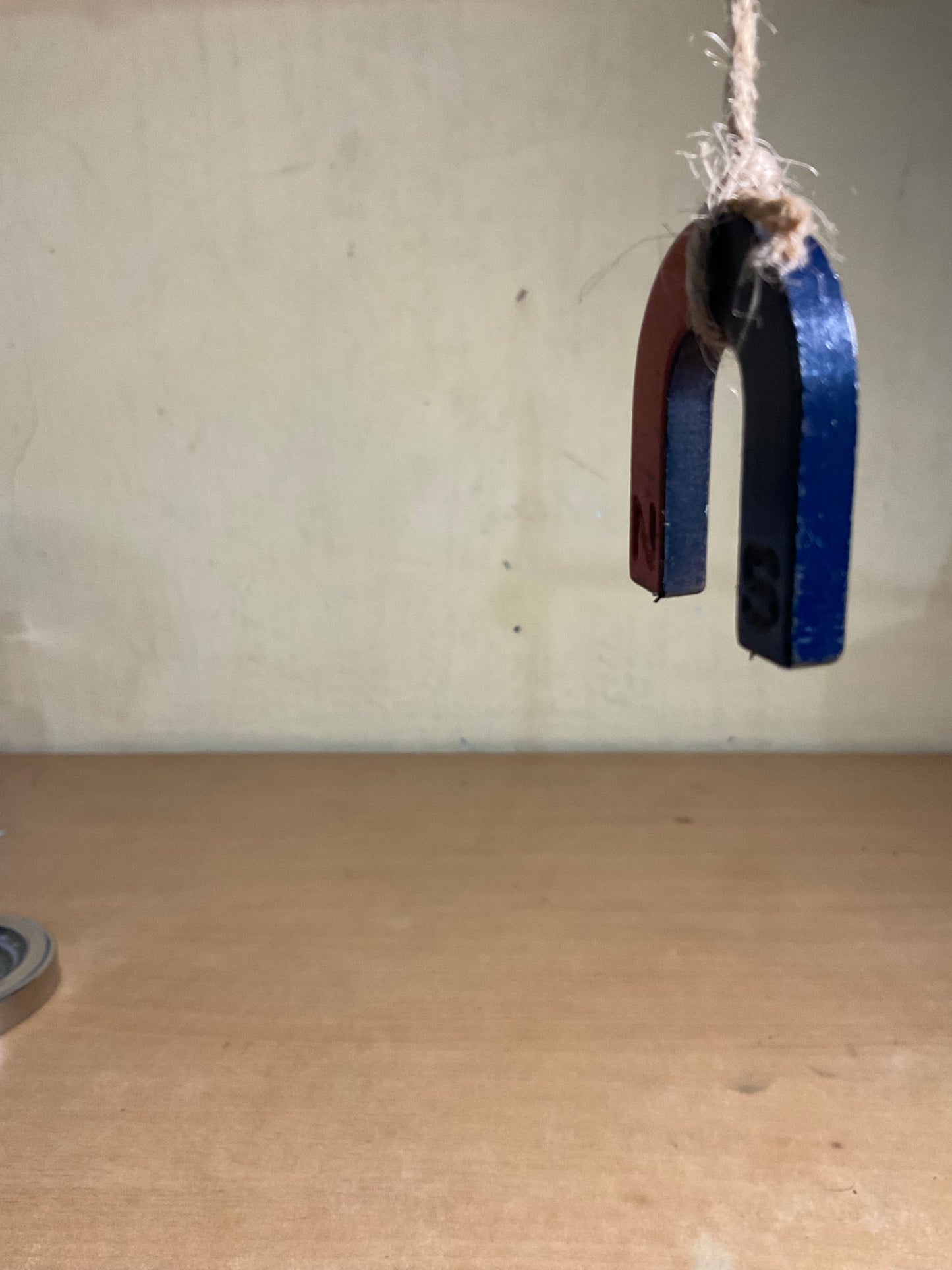
Suspend the magnet freely using thread.
Now something remarkable happens:
The magnet rotates and aligns itself with Earth’s magnetic field.
The magnetic torque tends to align the magnetic axis with the surrounding field.
A Deep Observation
If the magnetic axis is suspended vertically, the magnet may not rotate at all.
Why?
Because the magnetic axis already lies along the axis of suspension, so no turning torque acts about that direction.
This reveals something fundamental:
Rotation depends not only on force, but also on geometry and allowed degrees of freedom.
That is a profound physical idea hidden inside a very simple experiment.
Magnetic Dip — Earth’s Field Is Not Horizontal
Many people imagine Earth’s magnetic field as horizontal.
But it is actually tilted downward into Earth at most locations.
This tilt is called magnetic dip.
A freely suspended magnet therefore tries to align not only horizontally, but also vertically.
That means Earth’s magnetic field is truly 3-D.
The Big Question
How Can We Let the Magnet Rotate About Any Axis?
Ordinary hanging allows mainly one rotational freedom.
But a true 3D magnetic compass would allow unrestricted rotation.
This leads to fascinating engineering ideas:
- Gimbal suspension systems
- Magnetic pivots
- Floating magnets
- Spherical suspension
- Spacecraft attitude sensors
How to create a fully free magnetic orientation system?
That transition — from observation to invention — is what makes this experiment powerful.
Connection to Navigation and Earth Science
This experiment connects directly to:
| Experiment Idea | Real-World Application |
|---|---|
| Suspended magnet | Compass |
| Magnetic alignment | Navigation |
| Magnetic dip | Geophysics |
| Magnetic axis | Material science |
| Free rotation | Satellite orientation systems |
A scientific instrument can emerge from observing nature carefully.
Continue the Investigation
The experiment you've just explored is only the beginning. Our hands-on investigation sets are designed to help you recreate, extend, and deepen these ideas through observation and experimentation.
Every investigation has the potential to lead to a new question. If you discover something interesting, improve the experiment, or develop a new variation, share it with the Geometers community. Your work may inspire others and could even be featured here.
Keep experimenting. Keep questioning. Keep discovering.
Couldn't load pickup availability
Share