Geometers
From Mirrors to Kaleidoscopes: Building Symmetry
From Mirrors to Kaleidoscopes: Building Symmetry
A kaleidoscope creates beautiful patterns.
But where does that symmetry come from?
The answer lies in two simple plane mirrors.
By changing the angle between them, a single object can be repeatedly reflected and rotated around a common point.
A kaleidoscope is therefore not merely a toy.
It is a machine for creating symmetry.
Part 1 — Starting with Two Mirrors
The investigation began with two plane mirrors.
When the mirrors were nearly coplanar, corresponding to an angle of , only one reflected image was visible.
Then the angle between the mirrors was gradually decreased.
Something interesting began to happen.
The images were no longer seen as one continuous arrangement. They appeared through different angular regions.
As the angle between the mirrors decreased, these regions moved closer together.
This is already a geometrical problem.
By tracing rays, one can investigate:
- Which parts of the mirror produce each image.
- Why images appear in different angular regions.
- Why changing the mirror angle changes their positions.
Part 2 — The Surprise at 90°
When the mirrors reached an angle of , three images became visible.
This is a particularly interesting configuration.
Two images are easy to associate with the two individual mirrors.
But the third image seems to appear from nowhere.
In fact, it is produced by successive reflection from both mirrors.
The two mirrors are no longer acting independently.
Light can reflect:
- From the first mirror.
- From the second mirror.
- From both mirrors in succession.
That third image is an important discovery because it introduces the central mechanism of the kaleidoscope:
Reflections can generate further reflections.
Part 3 — From Images to Symmetry
Next, three cotton ear buds were used as simple objects.
Different arrangements of the buds were placed between the mirrors.
At , the repeated images created a pattern with fourfold rotational symmetry.
A shape placed in one region was reproduced and rotated around the central point.
By changing the arrangement of only three simple objects, many different symmetric patterns could be generated.
The mirrors were acting as a symmetry generator.
Changing the Angle
The angle between the mirrors was then decreased.
Around , the repeated images can produce fivefold rotational symmetry.
A single arrangement can be repeated around the central point to form a regular pentagonal structure.
Around , sixfold symmetry appears.
This suggests a beautiful geometrical relationship between angle and n-fold symmetry.
The mirror angle determines how many copies can fit around a complete rotation.
But There Is an Important Detail
The repeated images are not simply independent copies.
Each successive reflection changes orientation.
This is why the resulting pattern can contain alternating reflected versions of the original shape.
That makes the kaleidoscope especially interesting.
It generates symmetry through a combination of:
- Reflection
- Rotation
- Repetition
Part 4 — Closing the Mirrors
So far, the images have been arranged around a single central point.
But the reflected space is still open.
The next question is:
Can we close the mirrors and turn this repeated reflection into an optical instrument?
The answer leads directly to the kaleidoscope.
Two different configurations were explored.
Configuration 1 — A Square Arrangement
Two perpendicular mirrors can create fourfold repetition.
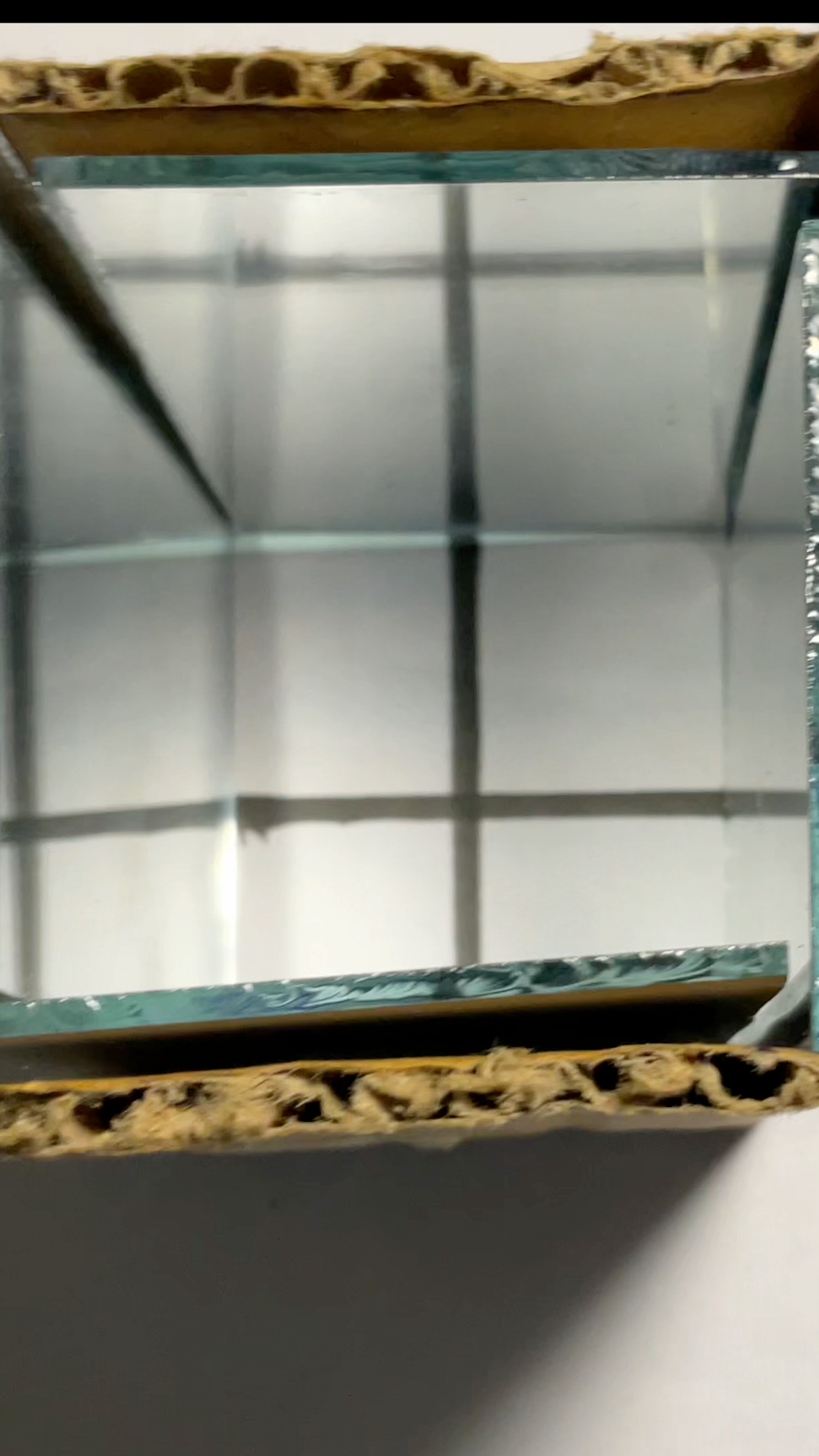
By adding more reflecting surfaces, the structure can be closed into a square cross-section.
This creates a cuboidal mirror tube.
The important geometrical idea is that reflections now repeat the pattern across a rectangular arrangement.
Configuration 2 — The Triangular Kaleidoscope
Three mirrors can be arranged to form a triangular tube.
If the internal angles are chosen appropriately—for example, 60 degrees —the reflections repeat around the tube and create the familiar kaleidoscopic symmetry.
A small pattern placed at one end is multiplied many times.
The observer sees a complete symmetric design.
Building an Adjustable Kaleidoscope
This construction method is particularly nice because it is not limited to one geometry.
Four equal rectangular mirror strips were cut and attached to paper.
Because the mirrors were connected by a flexible backing, the structure could be folded into different configurations.
The same set of mirrors could therefore become:
- A square or rectangular reflective tube.
- A triangular kaleidoscope.
This is much more interesting than building one fixed kaleidoscope.
It becomes an instrument for exploring how geometry controls symmetry.
Part 5 — Creating Patterns
Once the mirror structure is prepared, the user can begin experimenting.
A simple pattern can be placed at the viewing end.
For example, two equal perpendicular lines intersecting at a point can generate a repeated rectangular tiling pattern in a square configuration.
The intersection point becomes an important reference point for the symmetry.
By moving the kaleidoscope relative to the drawing, different patterns can emerge.
Why Use Tracing Paper?
Tracing paper provides an interesting way to illuminate the pattern.
A design can be drawn on tracing paper.
When the paper is illuminated from behind—for example, using a bulb—the light passes through the translucent material.
The pattern then becomes visible through the reflective structure.
This allows the kaleidoscope to work not only with physical objects but also with:
- Drawings
- Lines
- Shapes
- Coloured patterns
The user can therefore design a pattern and immediately investigate how reflection transforms it.
Continue the Investigation
The experiment you've just explored is only the beginning. Our hands-on investigation sets are designed to help you recreate, extend, and deepen these ideas through observation and experimentation.
Every investigation has the potential to lead to a new question. If you discover something interesting, improve the experiment, or develop a new variation, share it with the Geometers community. Your work may inspire others and could even be featured here.
Keep experimenting. Keep questioning. Keep discovering.
Couldn't load pickup availability
Share