Geometers
Can Air Stop Water? — Exploring Pressure in Fluids
Can Air Stop Water? — Exploring Pressure in Fluids
Take a bottle filled with water.
Make a small hole near its bottom.
Water rushes out.
Now close the bottle.
The water stops.
Nothing has blocked the hole.
So what stopped the water?
The answer leads us into the invisible world of pressure.
And when we make a second hole, the bottle begins to behave in an even more surprising way.
Part 1 — The First Hole
A cylindrical bottle was provided with a small hole near its lower portion.
The hole was initially covered with a thumb.
The bottle was filled with water and the cap was left open.
When the thumb was removed, water immediately began to gush out.
This is unsurprising.
There is water above the hole, and gravity produces a pressure within the water that drives the flow outward.
But now comes the interesting part.
The bottle was capped.
The water stopped flowing.
The hole was still open.
Nothing was physically blocking it.
The cap had somehow changed the conditions inside the bottle.
What Happened?
When water leaves a completely sealed bottle, the volume occupied by the water decreases.
The trapped air above the water expands.
As the air expands, its pressure decreases.
Eventually, the pressure conditions inside the bottle can reach a state where the pressure difference driving water through the hole disappears.
At that point:
Atmospheric pressure outside the hole balances the pressure acting from inside the bottle.
There is no longer a net pressure difference to drive continuous flow.
The water stops.
Part 2 — Make Another Hole
Now the experiment becomes much more interesting.
A second hole was made slightly above the first one.
The bottle was filled with water.
With the bottle uncapped, water emerged from both holes.
But the streams were not identical.
The stream from the lower hole travelled farther.
The stream from the upper hole travelled a shorter distance.
This immediately suggests:
The water is leaving the two holes with different velocities.
Why?
Because the pressure inside the water is not the same everywhere.
Pressure Gradient
The deeper the hole is below the water surface, the greater the hydrostatic pressure at that location.
For a stationary fluid, the pressure increases with depth.
Lower hole → greater pressure → greater outflow speed
and
Upper hole → smaller pressure → smaller outflow speed.
The different trajectories of the two streams therefore provide a visible demonstration of a pressure gradient that cannot be seen directly.
Part 3 — Close the Cap Again
Now comes the really beautiful observation.
The bottle was capped while both holes remained open.
One might predict:
Both streams should stop.
But that is not what happened.
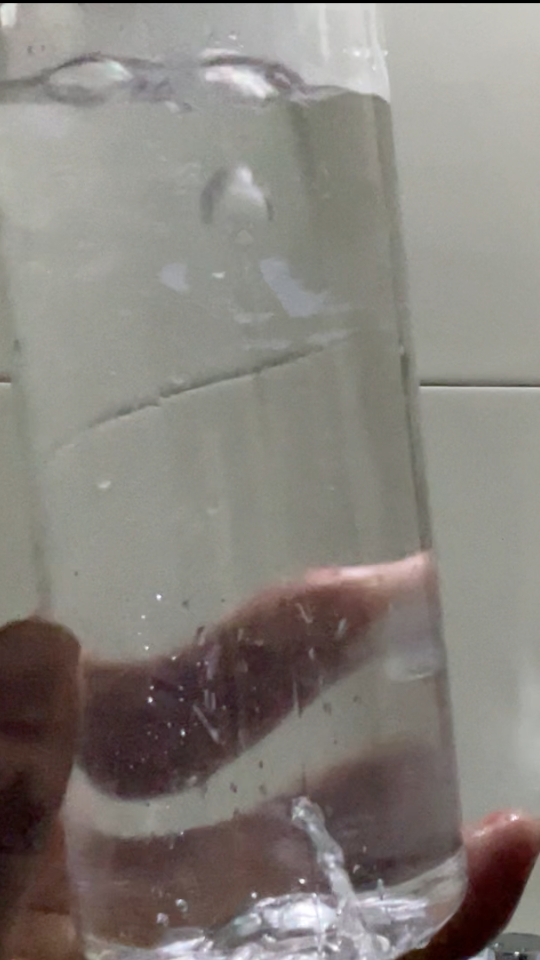
Water continued to emerge from the lower hole.
At the same time, something unexpected happened at the upper hole:
Air began entering the bottle through the upper hole as bubbles.
What Is Happening?
Once the bottle is capped, water leaving the lower hole causes the trapped air above the water to expand.
Its pressure decreases.
Initially, this reduced pressure may become comparable to the atmospheric pressure at the upper hole.
But water can still escape through the lower hole because the pressure there is greater due to the additional depth.
As water continues leaving, the pressure of the trapped air falls further.
Eventually, the pressure inside near the upper hole becomes lower than atmospheric pressure outside.
Atmospheric air can therefore enter through the upper hole.
You get a remarkable cycle:
Water exits through the lower hole
↓
Pressure inside decreases
↓
Air enters through the upper hole
↓
The pressure is partially restored
↓
Water can continue leaving
This is why you see the characteristic bubbling.
A Beautiful Question
Why does air enter through the upper hole while water is simultaneously leaving through the lower hole?
The answer forces us to stop thinking of "pressure inside the bottle" as a single number.
There is a pressure gradient within the water.
The pressure at the lower hole can be greater than the pressure at the upper hole.
That difference allows two different flows to occur simultaneously.
Part 4 — What If the Hole Is at the Bottom?
Suppose we make the only hole at the base of the bottle.
Close the cap.
There is no upper hole through which air can enter.
One might initially expect:
Water should still fall out because gravity is acting downward.
But experimentally, the water can remain inside.
Why?
Because gravity does not by itself determine whether water flows through an opening.
Flow depends on the pressure difference across the opening.
The pressure at the hole inside the bottle is determined by the pressure of the trapped air plus the hydrostatic contribution.
The atmospheric pressure outside pushes upward on the water at the opening.
Under the appropriate conditions, these effects can balance.
So even though gravity is acting downward:
There is no net force driving continuous flow through the hole.
This is a very useful correction to the intuitive idea that "water must come out because gravity pulls it down."
The Deeper Lesson
This experiment demonstrates something fundamental about fluids:
A fluid does not flow simply because gravity acts on it. It flows when there is an appropriate pressure gradient or pressure difference.
Gravity creates a pressure gradient in a fluid.
But other sources of pressure—such as trapped air and atmospheric pressure—can oppose or balance it.
This is why the same bottle can exhibit:
- Continuous flow
- No flow
- Two simultaneous flows in opposite directions
- Intermittent bubbling
simply by changing the arrangement of its openings.
Continue the Investigation
The experiment you've just explored is only the beginning. Our hands-on investigation sets are designed to help you recreate, extend, and deepen these ideas through observation and experimentation.
Every investigation has the potential to lead to a new question. If you discover something interesting, improve the experiment, or develop a new variation, share it with the Geometers community. Your work may inspire others and could even be featured here.
Keep experimenting. Keep questioning. Keep discovering.
Couldn't load pickup availability
Share